Pages

Showing posts with label librarians. Show all posts

Tuesday, January 22, 2013

The Internet Is Alive--With The Sound Of Intelligent, Passionate Librarians Speaking!

Wow! It has been an amazing start to 2013 throughout library-land online!  Although I maintain this blog and a Twitter account, I've generally been much more of a consumer than a contributor to the wonderful world of librarian, educators, kid lit, and YA lit bloggers.  The simplest reason for this fact is the sad reality that I have yet to figure out how to balance a regular blogging schedule with both my job and my life beyond work. However, the more powerful (and less embarrassing) reason is that there is simply so many amazing librarians, educators, and authors sharing a plethora of outstanding material!  And as a young and still very inexperienced librarian, it's both intensely overwhelming and incredibly comforting.  I don't believe I could have survived either my adventures as a grad student intern in children's departments at public libraries or my first year and half as a middle and high school librarian without the wild and wonderful online community surrounding libraries.

So why am I writing this post now?  After all, I've been reading blogs and following Twitter feeds related to reading, education, kid/YA lit, and librarianship for about 3 years.  Well, it just happens that there has been a bumper crop of brilliant and incredibly relevant posts written about librarianship, youth services, kid/YA lit, and more over fews weeks.  And so I thought--why don't I pull together a bunch of these awesome links in one place?

As usual, taking time to check up on the latest from Liz Burns (@LizB) and Kelly Jensen (@catagator) on Twitter pays off big time.  Both pointed us toward a fabulous piece posted by Julie Jurgens (@himissjulie) about modern librarianship, the frequently skewed spotlight in the library world, and the under-appreciated daily realities of librarian life.  It's not only a very important piece of writing-- it's also a great conversation starter, provoking thought and discussion about very diverse and complicated world of modern librarianship.  As someone who got into libraries with the goal of working with children and teens and who did her first semi professional work in children's departments of public libraries, I have to say that the librarians working on the ground--especially those working with children and youth--do not always get the recognition they very much deserve.  Rehearsing puppet shows, leading toddlers through movements of a new storytime welcome song, helping a 10 year old decide on a new series to begin reading while he waits for the next Rick Riordan novel to be published, or showing a teen where the Sarah Dessen books are shelved--these do not sound like glamorous activities to many people.  But they are the backbone of libraries, of literacy, and of education in United States.  If we care about education, about children, and about our future, we absolutely must care about all libraries and librarians, especially those serving children and youth.  And we have to demonstrate that care though action and advocacy.  Because picture books and story times and puppets and children's series fiction MATTER-- even if they don't sound "cutting edge" or "sexy."

Whew! Anyway, that's my two cents on the subject.  There have been many more eloquent responses from librarians--check out Kelly Jensen's recent posts over at Stacked and Julie Jurgen's twitter feed (@himissjulie) to track some of them.

In other fun and fabulous librarian blog news, both Abby Johnson and Kelly Jensen recently wrote up some particularly wonderful posts as part of their regular features "Around the Interwebs" and "Links of Note."   Both collect a bunch of really great and diverse links that I will not try to recreate here--go check them out!  And then go follow the tags for those features and check out their past posts for even more online goodies.

Meanwhile the brilliant Jennifer LaGarde AKA LibraryGirl (@jenniferlagarde) posted a wonderful piece about neuroscience, affective learning, and libraries! Such a great example of taking recent research and tying it directly to real, everyday work in libraries!

Yesterday, awesome librarian Sarah Bean Thompson over at GreenBeanTeenQueen posted a really helpful piece about reading and writing critically about children's and young adult literature!  She not only gives some great advice (especially for newbies like me) but also references some specific professional books and links out Kelly Jensen's critical reviewing cheat sheet  as well as her posts on the value of critical reviews and on critical reviews & critical advocacy.

I also want to include a link to The Nerdy Book Club, an awesome collaborative blog that I have only recently started reading regularly--shame on me! The posts in the last 5 days alone are all amazing and if you aren't already checking the blog regularly, start today!

Finally I just want to express my general thanks to all the wonderful librarians, educators, and authors sharing their insights, ideas, and advice with such generosity! Take it from one newbie librarian--your contributions are insanely valuable and greatly admired;  you make me proud to be a librarian and your examples constantly challenge me to be a better librarian.  Thank you! 

Check out my ever growing Diigo list of Librarian/Educator Bloggers to see why I'm so thankful! 


Monday, June 6, 2011

Limited Visibility: My Response to THAT WSJ Article

Whew! I woke up yesterday morning to an Internet storm in the young adult lit blogosphere. If you frequent young adult lit blogs or follow YA authors on Twitter or are on a young adult services listserv, you will have likely read the now infamous article in the Wall Street Journal, "Darkness Too Visible" written by Meghan Cox Gurdan.  If not, check it out here.  


First, I'll say that there are so many extremely articulate and wonderfully thoughtful responses to this article by bloggers, librarians, and authors--I'm including a list of links to several of them at the bottom of this post.  Please check them out because they are far more experienced and eloquent than I am.  


Now, this WSJ article got me riled up for a large number of reasons.  There's such a great deal about it that frustrates me that I'm almost unsure where to begin.  I think that my objections can be tied into one overarching problem with this article: it's extremely limited viewpoint.  The article's content demonstrates a very narrow understanding of young adult literature, of young adults, and of librarians, authors, editors, and others in the industry.  


Firstly, the article begins by describing the experience of one mother who was very unsatisfied and unhappy with the selection of books in her local Barnes and Noble's teen section; she felt that there was nothing appropriate for her 13 year old daughter, saying: "It was all vampires and suicide and self-mutilation, this dark, dark stuff."  The author goes on to agree with this statement, stating that "kidnapping and pederasty and incest and brutal beatings are now just part of the run of things in novels directed, broadly speaking, at children from the ages of 12 to 18."  I have to say that such statements are indeed very "broadly speaking."  This generalization about the range of materials out there for young adults is especially frustrating because it is patently untrue.  I frequently find myself explaining to people that YA literature is not just one thing; it is not all vampire love stories or angsty prom tales or 'problem novels.'  Just like adult literature, young adult literature is extremely diverse.  Books dealing with some darker issues or situations are one type of fiction out there aimed at teens; they are far from the only kind of young adult literature being published and read right now.  What about the fabulously fun or romantic or hilarious or whimsical young adult novels out there? Additionally, not all teen fiction is aimed at the same age group; most YA literature is not created for the entire 12-18 demographic.  As other bloggers have noted already, if this mother had walked into a library and asked a teen or children's librarian for some advice, she likely would not have left empty-handed.  


The main thrust of the article is that the fiction being published for teenagers is too dark, covering topics previously considered taboo such as sexual and physical abuse, self-mutilation, depression, suicide, sexual assault, etc.  Other bloggers have articulated nicely that young adult literature has essentially contained 'problem novels' or issue-driven stories dealing with difficult topics since the genre has existed.  I would rather simply point out why I, as a librarian and youth advocate, feel that books addressing these topics are important.  I was a lucky kid--I lived a safe and comparatively happy life as a child and an adolescent.  But I knew that the scary stuff was out there; I either knew of or was friends with young people who dealt with some or several of these situations.  For a lot of teens, total innocence or ignorance of the dark side of life is simply not a reality.  Now that I am older, I am even more aware of the fact that for many young adults, abuse, self-injury, or sexual assault are things of reality rather than fiction.  Do I think that this means that every young adult should read about these topics? Of course not--each kid is unique and has distinct reading preferences and needs.  But I do think that the attempt to give a voice to the voiceless should not be dismissed as easily as Ms. Gurdon seems to feel it can be.  When we say that these topics cannot be written about--that they are dirty and depraved and so should be hidden in the dark--what message are we sending to the young survivors of abuse, assault, or depression?  We are telling them that their stories do not matter; we are saying that these realities should not be discussed.  As someone who has made it her job to care about young adults, I believe that such action is simply not okay.  


In her conclusion, Ms. Gurdon states that "book business exists to sell books; parents exist to rear children"; I would like to add to that that librarians (and along with other members of the young adult literature community) exist to defend each child's individual right to read and to provide a diverse literature in support of each child's discovery and understanding of the world around her and her place in it.  This difference in objectives ties into my last quibble with this article: there is a distinction between banning and guidance.  When we discuss censorship or book banning, we mean the demand that an item be removed from access by the public or by a large group of people (such as students at a particular school) based on the objections of an individual or a group.  Meanwhile guidance is on individual, personalized basis.  Parents should talk with their children about what they're reading; please do! However, individuals do not have the right to extend such guidance to other children or young adults.  


To end on an inspiring note, please check out the myriad of responses on Twitter using the hashtag #YAsaves; hundreds of teens and adults have shared their personal examples of how powerful stories written for teens can be.    


Here are a few of the great responses to this article so far- check them out! 


Liz B. @ A Chair, A Fireplace & A Tea Cozy,  "There's Dark Things in Them There Books!"  

Stephanie Lawton, "YA Under Attack: Heaven Forbid We Address Reality" 

Libba Bray's recent Twitter feed compiled by WSJ 


Linda Holmes @ NPR's Monkey See, "Seeing Teenagers As We Wish They Were: The Debate Over YA Fiction"

Elizabeth Bird @ A Fuse 8 Production, "Fusenews: Hand Me My Smelling Salts! I Think I Have the Vapors!"

Laurie Halse Anderson, "Stuck Between Rage and Compassion" 


bookshelves of doom has a response and a round up of other responses 


 Mary Elizabeth Williams at Salon Magazine, "Has Young Adult Fiction Become Too Dark?"

Malinda Lo, "The Moral of the Story" 

Tuesday, August 3, 2010

In Which This Cupcake Gets A Bit Riled About Libraries and Censorship

Today is a very special day. Today is the first day I am actually blogging about something directly library-related! Woohoo! As a passionate library-lover and librarian-in-training, I try to keep up to date on all that is going on in the library world. When I caught the full details on this story via the School Library Journal article last week, I knew would have to blog about it. While I am a generally passionate person who cares a great deal about many issues, there are a few issues that get me particularly riled up. Censorship is definitely one of those especially riling issues.


So what happened? Well, earlier this April the library director of the Burlington County Library System, Gail Sweet, requested the Library Commissioners’ approval in the pulling of Revolutionary Voices: A Multicultural Queer Youth Anthology from the shelves. Apparently this event was prompted by a request for the book’s removal by the 9.12 Project, a conservative group created by Glenn Beck. From emails gathered by the ACLU of New Jersey via a Freedom of Information Act, it appears that a formal request for the book’s removal was never made; Ms. Sweet and a colleague simply decided that the book should be removed from the shelves and were then supported by the library commissioners. When a librarian within the system asked the reason behind the book’s removal, Sweet replied with merely two words: “child pornography.” It might be good to note here that Revolutionary Voices was named one of the best adult books for high school students by School Library Journal in 2001 and has been recognized by the Gay, Lesbian, and Straight Education Network (GLSEN) as a unique resource that is one of the first to really be applicable to “queer and questioning youth of every color, class, religion, gender, and ability.”


So why does this rile me up? Well, first of all, my decision to pursue library science was based on a combination of factors but one of the main reasons was the American Library Association’s incredibly strong stance on censorship and our first amendment rights. Librarians are ideally the defenders of such rights who aim to work against censorship. So, librarians would ideally be the ones resisting requests for the removal of books rather than those doing the requesting. My librarian idealism is deeply offended by the concept of a librarian giving in to such a challenge in the first place. However, the ALA also recognizes the difficult situations librarians can find themselves in concerning their collections and so recommends that every library have a written policy that details the selection process used in choosing materials for the collection. Also, many libraries use a formal process to handle challenges. These measures protect against allowing a single opinion to determine the content of the library’s collection, which is a shared source of free information for diverse populations. In this situation, the procedures were all ignored; materials were completely removed from the library shelves without any official request and based on the opinions of two people supported by a committee that did no further investigation. Frankly, this behavior just undermines the authority of libraries and librarians around the country and the world to work for free speech and open access to information. And, so it riles me. I mean, not be completely cheesy or anything, but I really believe that free speech, free press, and open access to information are basic human rights and the key building blocks to a successful democracy. Libraries and librarians currently play one of the most important roles in defending these rights. And so it breaks my little idealistic heart to hear about things like this happening.


Well, there was my censorship rant. In other news, I already struggled with WFMAD by forgetting to do my writing yesterday. But I did a make-up this morning and I vow not to forget again! Laurie has posted some great prompts on her blog every day so if you are participating and running low on ideas, check it out! But, to end on a happy note, I received the coolest little gift ever yesterday: my friend sent me a Time Turner from the Wizarding World of Harry Potter! AWESOME! Look how cool it is:


I can be even more like Hermione! YES! It is now one of my great geek treasures, right up there with my Jane Austen bobble-head. Anyone else out there have some favorite geeky possessions? Or an opinion about this NJ censorship business? I promise to respond to comments promptly!

Wednesday, May 26, 2010

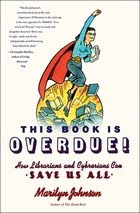
This Book Is Overdue! How Librarians and Cybrarians Can Save Us All by Marilyn Johnson


This Book Is Overdue! How Librarians and Cybrarians Can Save Us All


Marilyn Johnson


SUMMARY: In a world suffering from an overload of information, librarians are the capable guides who willingly and freely offer their expertise to the populace daily in a variety of traditional and unexpected venues. Marilyn Johnson’s newest book supports this statement through an exploration of a diverse sampling of the fantastic, fun, brave, and bizarre people who make up the field.


ONESMARTCUPCAKE THINKS: Since I decided that library science was my chosen career and destiny, my friends constantly send me varied links about libraries and librarians. This book was one of these many links and it caught my eye immediately. I finally got my paws on it last week and speed through it with great relish.


Johnson has a fun and very readable writing style. I feel that her quirky but well-researched approach to this topic works very well in producing a book appealing to the average reader as well as the library and information professional. Johnson’s examples run the gamut of librarians and cybrarians, ranging from blunt bloggers to social activists to tattooed children’s librarians and beyond.


In this book, Johnson has managed to capture the passion, humor, and commitment of modern librarians. She illustrates the many facets of this quickly evolving profession and makes a convincing case for its continued relevance and necessity. However, despite her obvious admiration for librarians and their diverse sub-cultures, Johnson maintains a sense of balance and a critical eye. The result is a frank but inspiring exploration of librarians, cybrarians, and their key place in modern society. I really enjoyed this book both for its subject matter and Johnson’s fun but informative style. Her previous book, The Dead Beat, deals with the fascinating world of obituaries and I can’t wait to track down a copy and check it out.


5/5 STARS